
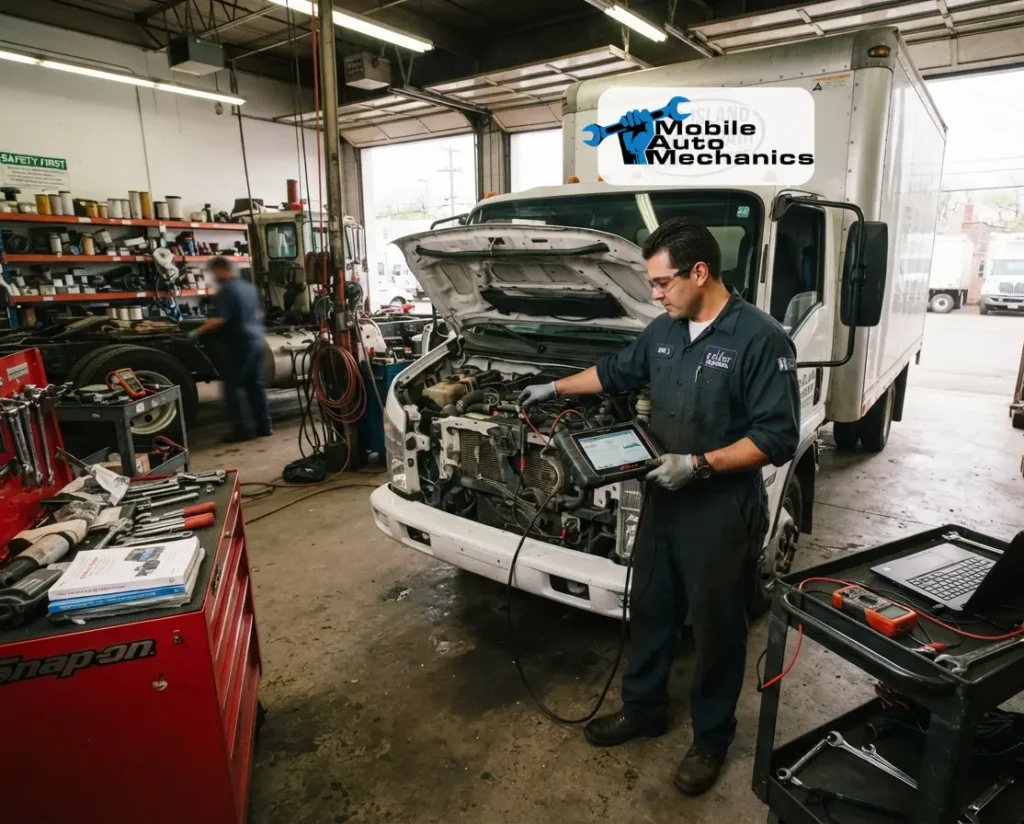
When a mechanic misdiagnoses your personal car, you lose an afternoon. When one misdiagnoses a fleet truck, you lose the truck twice: once for the wrong repair, and again when the real problem pulls it off the route a week later. That is why who works on your fleet is an operations decision, not just a maintenance one.
ASE certification is one of the clearest signals of a qualified technician, and it comes up whenever a fleet manager vets a service provider. Most explanations of it are written for the technician chasing the credential or the driver dropping off a sedan. Here is what ASE certification actually means, what it takes to earn one, and how to read it when you are deciding who keeps your trucks running.
What ASE certification is, and what it is not
ASE stands for the National Institute for Automotive Service Excellence. It has been the industry’s testing and certification body since 1972, and it is an independent, non-profit third party. It is not a government agency and certification is voluntary, so it is a professional standard rather than a legal one. When people call ASE the industry benchmark for technician competence, that is what they mean.
One detail matters more than any other for a fleet buyer: ASE certifies individual technicians, not shops. A business can employ certified people, but the credential belongs to the person, listed by the specific systems they were tested on.
There is a separate, shop-level recognition called the Blue Seal of Excellence. A facility earns it when at least 75% of the technicians doing diagnosis and repair are ASE certified and every service area offered is covered by at least one certified technician. So “we have a certified tech” and “we are a Blue Seal shop” are two different claims, and it is fair to ask which one a provider is making.
What actually qualifies a technician to be certified
This is the part most fleet managers never see, and it is what gives the credential its weight. Becoming ASE certified takes two things, not one.
Hands-on experience. A technician needs a minimum of two years of relevant work experience, or one year plus a two-year degree in automotive repair. Formal training can substitute for part of the experience requirement, but it cannot replace it entirely. Someone can sit the exam before meeting the experience requirement, but the certification is held until that experience is documented.
A passed exam in that specialty. The tests are computer-based, run through Prometric test centers, and each one carries roughly 40 to 75 scored questions written and reviewed by a national panel of working technicians, manufacturers, and educators. The questions are built around real repair scenarios, not textbook trivia, and a technician generally needs about 70% to pass. Certifications are specialty-specific, so a tech is certified in the exact areas they passed, nothing more.
Then there is the part that keeps it honest: certification expires and must be renewed every five years through recertification testing. That is why “I passed an ASE test once” and “I am currently ASE certified” are not the same statement. The five-year cycle is what keeps a certified technician current on systems that change fast, which on modern trucks they do.
A technician who passes the full series in an area earns Master Technician status, the top tier of the credential.
The certifications that matter for a fleet: the truck series
Here is where the fleet buyer’s version diverges from every consumer article. The A-series of ASE tests covers cars and light vehicles. That is not your fleet.
For commercial trucks and vans, the relevant credential is the medium and heavy truck series, the T-series. It covers exactly the systems that put a work truck out of service: diesel engines, drivetrain, brakes, steering and suspension, electrical and electronic systems, heating and air conditioning, and preventive maintenance inspection. A technician who passes the full series earns Master Medium/Heavy Truck Technician status.
That mapping is the whole point. A brake certification means the person adjusting your air brakes has been tested on air brakes specifically. A drivetrain problem on a heavy truck is a different animal from a drivetrain problem on a sedan, and the T-series exists because commercial systems demand their own expertise. When you ask a provider about certifications, the truck series is the one worth asking about, not a generic “are you certified.”
Why this matters more for a fleet than for a single car
A consumer gets one shot wrong and loses a Saturday. A fleet gets one shot wrong and loses a truck, a route, and often a second repair to fix what the first one missed. The stakes scale with the operation.
Certification lowers the odds of that miss. A technician tested and current on your truck’s systems is more likely to diagnose the real fault the first time, which is the difference between a truck back on the road once and a truck back in the shop that works on your fleet twice. Fewer comebacks, less downtime, and a repair history you can actually trust.
It also tells you something about the provider. A shop that invests in getting its people certified, and in keeping them certified through the five-year cycle, is signaling a standard it holds across the team. For a fleet that needs a service relationship to hold up over years, that signal is worth reading. It is one of the quieter markers of a vendor you can rely on, alongside response time and how well they know your trucks.
How to actually check a provider’s credentials
The good news is that verifying this is straightforward, and any legitimate shop expects the question. When you are evaluating who services your fleet, here is what to do:
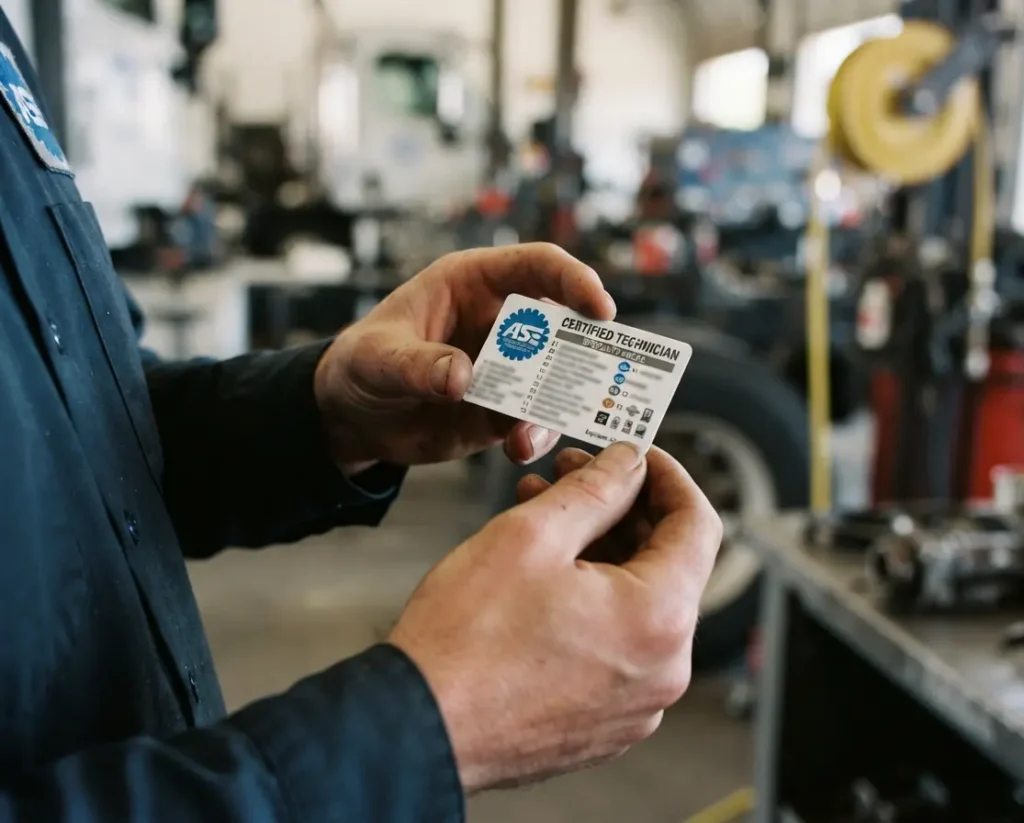
- Ask to see credentials. Every certified technician has a card listing the specific areas they hold. A provider standing behind its work will show you without hesitation.
- Ask about the truck series specifically. Certifications in the medium and heavy truck specialties are the ones relevant to your vehicles. General or car-only certifications are a weaker match for a diesel fleet.
- Ask whether the certifications are current. Because the credential runs on a five-year cycle, “certified” should mean certified now, not a decade ago.
- Verify it yourself. ASE maintains a way to look up certified professionals, so you are not relying on a wall plaque alone.
- Look across the team, not one person. One certified tech is a start. A provider where certification is the norm, or a Blue Seal facility, is a stronger bet for a fleet.
The same standard applies whether the work happens in a bay or onsite at your yard. A technician servicing your truck in your lot should be as qualified as one working in the shop, so the credential question does not change just because the service comes to you.
Trust but verify is a reasonable stance when trucks and uptime are on the line. Ask us, and ask any provider you are considering. The answer, and how willingly it comes, tells you a lot.
ASE certification FAQ
What does ASE certified mean?
It means a technician has met the National Institute for Automotive Service Excellence standard in a specific area: documented hands-on experience plus a passed, specialty-specific exam, kept current through recertification every five years. It is a voluntary industry credential, widely treated as the benchmark for technician competence.
What qualifies a technician to become ASE certified?
Two things. A minimum of two years of relevant hands-on experience, or one year plus a two-year automotive degree, and a passing score on the ASE exam for that specialty. Training can substitute for part of the experience, but the exam and the experience are both required.
Does ASE certify the shop or the technician?
The technician. ASE certifies individuals, and the credential lists the exact specialties they passed. A shop can be recognized separately through the Blue Seal of Excellence program when at least 75% of its diagnosing and repairing technicians are certified.
Which ASE certifications matter for a commercial fleet?
The medium and heavy truck series, the T-series. It covers diesel engines, drivetrain, brakes, steering and suspension, electrical systems, HVAC, and preventive maintenance inspection. Passing the full series earns Master Medium/Heavy Truck Technician status. Car-focused certifications are a weaker match for a work-truck fleet.
How do I verify a technician’s ASE certification?
Ask to see the technician’s certification card, which lists their specialty areas, confirm the certifications are current, and look the professional up through ASE’s own records. For a fleet, ask specifically about the truck-series certifications relevant to your vehicles.
The takeaway
Certifications do not turn a wrench, people do. But ASE certification tells you something real about the person under your truck: that they were tested on that system, met an experience bar to get there, and had to prove it again within the last five years. On a single car that is reassuring. On a fleet, where a wrong diagnosis multiplies into downtime, it is a practical filter for who you let near your trucks.